

These days I find myself watching TV shows and movies from the 1970s and 1980s. It’s not for personal nostalgia; rather, I enjoy the sense of calm they evoke. They offer a glimpse into a much simpler world—some of which I haven’t even experienced in my lifetime, a world that reflects a more innocent, and perhaps more sincere relationship between people and their surroundings.
The world from not so long ago looked much more at ease, even if people had far fewer conveniences of day-to-day life than we have today. People seemed much wiser even if they didn’t have information at their fingertips 24/7. They were much more in tune with themselves and with the world even if there were far fewer means and modes of communication.
Just a few decades ago, we were happier; we already had all we needed to be happy. If I glance into the lives of even older decades, I am sure I will reach the same conclusion—then too, we were happy; we already had all we needed to be happy. Perhaps we don’t realize that we have enough until we look at our past.
The knowledge of already having enough is not just a key to stopping the devastation of the natural world, but to our personal happiness too. A children’s picture book, “Fox & Bear“, reminded me of this simple fact. Children’s books, which often succeed in opening the hearts of the grown-ups, sometimes also offer to open our minds and eyes too. This book’s simple but thought-provoking premise reflects on the importance of appreciating what we already have, and the repercussions of disrupting the natural order.
Writer, illustrator, and wilderness guide Miriam Körner tells a story of a fox and a bear who used to live a blissful life in a forest, simply “gathering what there was to gather and to catch what there was to catch“.

The two friends were passing their days blissfully foraging and hunting for berries and eggs, and spent the rest of their time listening to the birds’ songs and watching sunsets – until one day, a temptation to be “more efficient”(in other words, gathering more in a given day,) crept into the mind of the fox.
They started with caging birds for more eggs and growing berries to have more. However, this proved to be time-consuming, so Fox developed a complex system of automated machines to feed birds, gather eggs, water plants, and pick berries. New tasks emerge, such as gathering wood for steam engines, refilling bird feeders, and building more cages. As their efficiency increased, so did the scale, load, and complexity of their work, requiring even more time commitment. As they started to cut trees and dig up hills for raw materials, they could not listen to birds’ songs or watch the sunsets. Now, their days started to feel lifeless.
As Fox keeps imagining bigger and bigger, speedier and speedier machines, Bear realizes that he is so exhausted, that he has no “imagination” left. Suddenly a moment arrives that brings him out of this illusion of “productivity” when he remembers how blissful it was to simply stroll through the forest “and gather what there is to gather and catch what there is to catch.”
When the serenity of their forest was robbed by the industrial noises and destructions brought about by their machines, and their fine living was lost to the race of being efficient and successful, the two friends realized that in their endless pursuit of “doing,” they were missing out on the inherent joy of simply “being” — being a part of the world around them, a world that was already attuned to meet their all important needs.
In last year’s edition of Nature Lover’s Conservation Calendar, I included this native American saying as a feature quote (which I change every year) on one of the initial pages:
When the Last Tree Is Cut Down, the Last Fish Eaten, and the Last Stream Poisoned, You Will Realize That You Cannot Eat Money.
These prophetic words stir my heart so much, that I have kept this quote for this year’s edition too. The saying sums it up all. And needs to be told repeatedly to us. Every year. Every day, rather.
Probably you are a concerned environment/wildlife champion, activist, educator, or you are involved in a sustainable business. Or, you simply love nature, because being part of the same nature, loving her could only be our innate response. In all these instances and more, I am hoping that you want to stay inspired and well aware of all the important environmental and wildlife observance dates of the year.
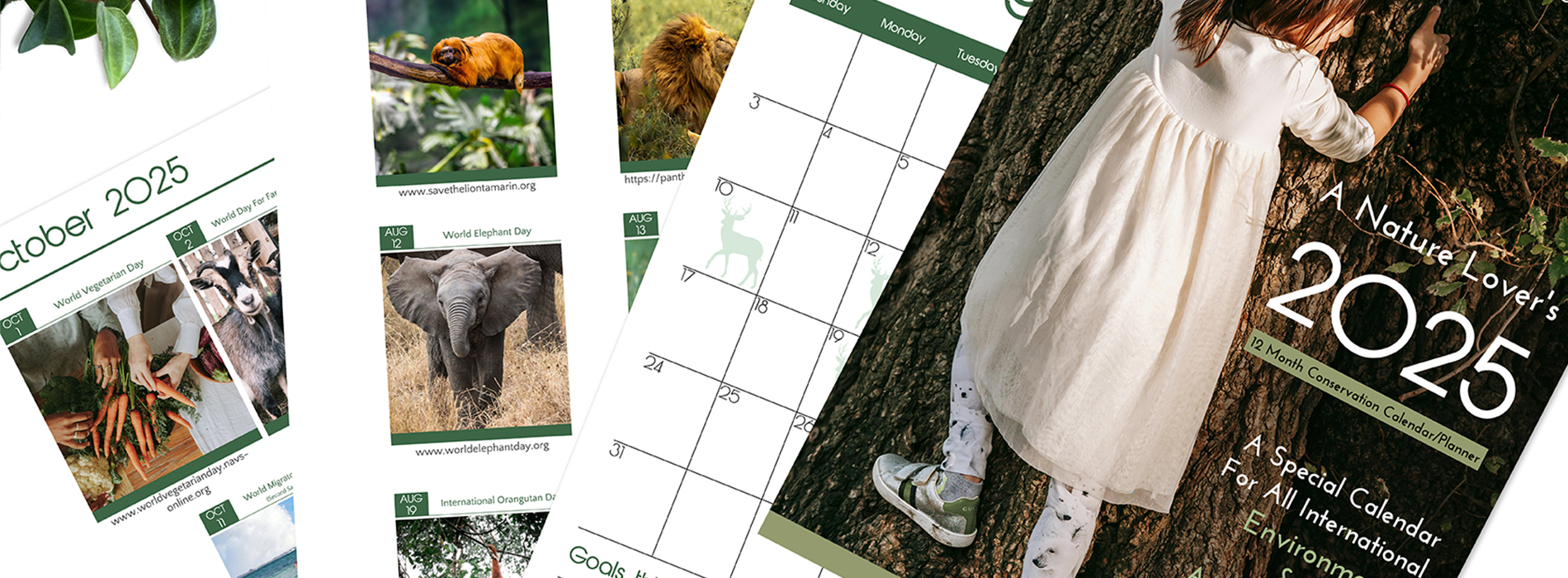
Here is my one-of-a-kind, printable calendar/planner for the year 2025, just for nature lovers and environmentally aware people. It features 76 major wildlife and environmental awareness days celebrated internationally and in the US.
Each awareness day is accompanied by a beautiful photograph of the subject and its official website address so that you know the best source for more information and how to contribute effectively when the causes most dear to your heart come before you.

I am sure you will enjoy using it as much as I have enjoyed creating it, and can’t wait to know your thoughts on it.
If you aren’t already a subscriber to my Nature Lover’s Conservation Calendar, subscribe below.
Download your FREE Conservation Calendar/Planner!
Important Note: The 2025 edition email will be sent to subscribers from 30th December 2024 onwards.
A list of all significant wildlife and environmental awareness days
celebrated worldwide and in the US – with links to their official websites.
Browse through the list and find out a cause dear to you! 🙂
January
January 5: National Bird Day (USA)
January 31: International Zebra Day
February
February 2: World Wetlands Day
February 10: World Arabian Leopard Day
February 15: World Hippo Day
February 15: World Pangolin Day
(Third Saturday of February)
February 16: World Whale Day
(Third Sunday of February)
February 27: International Polar Bear Day
March
March 3: World Wildlife Day
March 18: Global Recycling Day
March 20: World Rewilding Day
World Sparrow Day
World Frog Day
March 21: International Day of Forests
World Wood Day
March 22: World Water Day
March 22: Earth Hour
March 23: World Bear Day


April
April 7: International Beaver Day
April 17: International Bat Appreciation Day
April 22: Earth Day
April 25: World Penguin Day
April 25: Arbor Day (USA)
May
May 3: Wild Koala Day
May 10: World Migratory Bird Day -Spring (Second Saturday Of May)
May 16: Endangered Species Day (Third Friday Of May)
May 20: World Bee Day
May 22: International Day For Biodiversity
May 23: World Turtle Day
May 25: World Fish Migration Day
May 31: World Parrot Day
June
June 5: World Environment Day
June 8: World Ocean Day
June 9: Coral Triangle Day
June 15: Nature Photography Day
Global Wind Day
June 17: World Day to Combat Desertification & Drought
June 21: World Giraffe Day
June 22: World Rainforest Day
July
July: Plastic Free July
July 16: World Snake Day
July 26: International Day for the Conservation of the Mangrove Ecosystem
July 29: World Tiger Day


August
August 2: International Golden Lion Tamarin Day
August 10: World Lion Day
August 12: World Elephant Day
August 13: International Wolf Day
August 19: International Orangutan Day
August 30: International Whale Shark Day
September
September 12: World Dolphin Day
September 16: International Day for the Preservation of the Ozone Layer
September 20: World Cleanup Day
(Third Saturday of September)
International Red Panda Day
(Third Saturday of September)
September 22: World Car-Free Day
World Rhino Day
September 24: World Gorilla Day
September 26: World Environmental Health Day
September 28: World Rivers Day
October
October 1: World Vegetarian Day
October 2: World Day For Farm Animals
October 4: World Animal Day
October 11: World Migratory Bird Day – Fall
(Second Saturday Of October)
October 16: World Food Day
October 20: International Sloth Day
October 22: International Wombat Day
October 23: World Snow Leopard Day
November
November 1: World Vegan Day
November 6: International Day for Preventing the Exploitation of the Environment in War and Armed Conflict
November 15: America Recycles Day (USA)
November 17: Take a Hike Day (USA)
November 29: International Jaguar Day
December
December 4: Wildlife Conservation Day
December 5: World Soil Day
December 11: International Mountain Day



Leave a Reply