

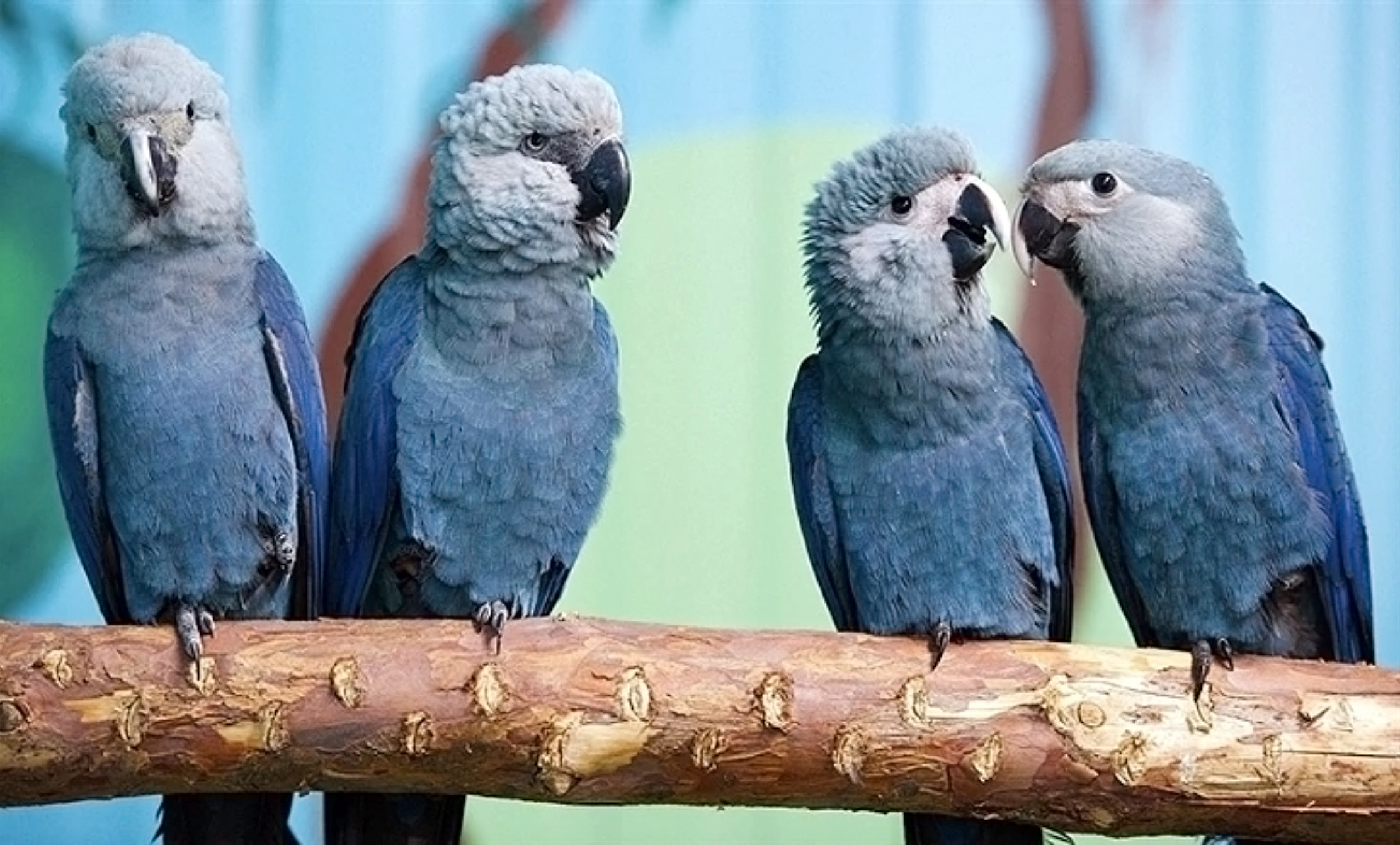
On June 11th, 2022 some rare turquoise blue wings fluttered in the sky over the mysterious, least-known biome of Cattinga, Brazil, the home where these wild and wonderous wings belong, but were not seen for over 20 years. That day, after being declared extinct-in-wild by IUCN, one of the rarest species on the planet, eight odd Spix’s Macaws had returned to their home in Brazil.
The bird’s last known sighting in the wild before this was in 2000. It is believed that before dying lonely, the last Spix’s Macaw in the wild roamed all alone in the forest of Bahia, Brazil, for about ten years in search of a mate. At that time, this bird was known as the “world’s loneliest bird”. This bird’s unfortunate story (of course with a changed, happy, ending) was even told by Hollywood, titled – “Rio“.
But the real story of the Spix’s Macaws was always stormy, and their existence was always mysterious and also unsafe. Science came to know about these rare parrots during the early 19th century, still, there was no sure knowledge among modern biologists and scientists about where the species occurred, until its rediscovery in the late 1980s. By then only three known individuals survived in the wild. The threats of habitat degradation due to expanding farming activities across Caatinga, poaching, and the illegal pet trade for decades drove the extinction of the Spix’s Macaws in the wild.
Ironically, it was captive birds that gave hope for the conservation of these birds.
For more than two decades, hundreds of scientists, veterinarians, conservation biologists, and ornithologists all over the world and Brazil’s indigenous people collaborated for relentless efforts at research and conservation of some handful of Spix’s Macaws left in the world, all of course, in captivity and human care. The ultimate aim was to reintroduce these rarest birds in the wild again. And of course, they saw the successful release of eight odd Macaws in their natural habitat in Brazil.
The German breeding organization behind this project released a video of these eight parrots flying freely toward their true home in the wilderness. To watch the birds slowly stepping out of the aviary, and taking flight into the wild for the first time after decades, was one of the most uplifting and beautiful things to watch, it made my heart race and my eyes, filled with tears of gratitude, and amazement.
And then, on May 24 this year, what happened could make any nature lover’s heart sing in pure bliss. Two parrot fledglings, born in the wild, took flight for the first time! Today, 11 Spix’s Macaws are flying free again in the Caatinga biome of northern Bahia. We can almost say that they are the first-ever species to actually “de-extinct”.
And, on May 24 this year, what happened could make any nature lover’s heart sing with sheer joy. Two parrot fledglings, born in the wild, had taken flight for the first time! Today, 11 Spix’s Macaws are flying free again in the Caatinga biome of northern Bahia. We can almost say that they are the first-ever species to actually “de-extinct”.
But before we can celebrate this, in the same month, news came out which could mean that – (and my fingers are trembling as I type this,) these marvelous birds may even be on their way to becoming extinct from the wild, again.
The reintroduction project was going on in collaboration between two institutions: the Association for the Conservation of Threatened Parrots (ACTP), the German breeding facility, and the Chico Mendes Institute for Biodiversity Conservation (ICMBio), the Brazilian government agency responsible for managing protected areas and biodiversity. However, in May 2024, ICMBio announced the discontinuation of their technical cooperation agreement with the ATCP, which ended in June.
While none of the above organizations would be stepping away from their conservation actions, a very promising and exceptionally successful collaboration for the reintroduction program for Spix’s Macaw is thrown into doubt today.
I won’t comment on this shocking, unfortunate turn of events. I may not be qualified to know enough of the technicalities in the matter. All I know is, that these on-the -brink-of-extinction birds have taught us a lot about conservation, they have demonstrated remarkable learning abilities, an inspiring will to survive as a species, and have shown how resilient nature can be if we just let it be. Once again, in one way or another, probably it’s us that’s coming in their way, in nature’s way.
Here is my poem dedicated to Spix’s Macaws, and all the conservation efforts for them, it is inspired by a stunning moment of 11th June 2022 that I watched in a video – when the first Spix’s Macaw stepped out of the reintroduction facility aviary in Brazil, into its original wild habitat, to take flight after two long decades – in its home sky.



Leave a Reply